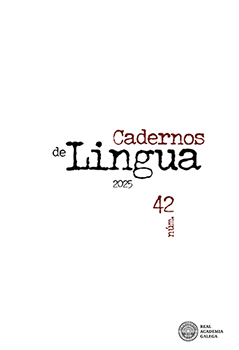
The gender variable in teaching linguistic practice
empirical analysis and interpretive contrast
DOI:
https://doi.org/10.32766/cdl.42.896Keywords:
gender, intersectionality, education, languages, sociolinguistics, linguistic accommodationAbstract
This article explores the impact of gender on the linguistic practices of Galician teachers through a comparative analysis. It draws on data from the study Lingua e xénero en Galicia: estado da cuestión (López-Sández, Loredo & Vázquez-Grandío 2022) and a new empirical study based on 241 surveys administered to secondary school mathematics teachers. The findings validate several previously proposed hypotheses —such as the greater tendency among women toward linguistic convergence and communicative accommodation— as well as indications of shifting attitudes among younger generations regarding identification with the Galician language. At the same time, other hypotheses are either qualified or challenged. These results underscore the importance of integrating a gender perspective into sociolinguistic research and highlight the need for continued investigation into the intersections between language, identity, and gender within educational contexts.
Downloads
References
Castro Vázquez, Olga (2010). Galego+non sexista: como e por que avanzarmos cara a unha outra representación de xénero na lingua. En: Xesús M. Mosquera Carregal, ed. Lingua e xénero: VI Xornadas sobre lingua e usos. A Coruña: Universidade da Coruña, 33-62.
Crenshaw, Kimberle (1991). Mapping the Margins: Intersectionality, Identity Politics, and Violence against Women of Color. Stanford Law Review. 43(6), 1241-1299.
García Negro, M.ª Pilar (2010). Dúas subordinacións en paralelo: mulleres e lingua galega. En: Xesús M. Mosquera Carregal, ed. Lingua e xénero: VI Xornadas sobre lingua e usos. A Coruña: Universidade da Coruña, 79-88.
Hermida Gulías, Carme (2010). Lingua e sexismo en dicionarios de galego. En: Xesús M. Mosquera Carregal, ed. Lingua e xénero: VI Xornadas sobre lingua e usos. A Coruña: Universidade da Coruña, 89-114.
Hill Collins, Patricia e Bilge, Sirma (2016). Intersectionality. Cambridge, UK: Polity Press.
Labov, William (1966). Principios del cambio lingüístico. Madrid: Gredos.
López-Sández, María; Loredo, Xaquín; e Vázquez-Grandío, Gabino S. (2022). Lingua e xénero en Galicia: estado da cuestión. A Coruña: Real Academia Galega.
Loredo, Xaquín e Silva Valdivia, Bieito (2020). Avaliación da competencia bilingüe nos idiomas galego e castelán do alumnado de 4º da ESO. A Coruña: Real Academia Galega.
Mosquera Carregal, Xesús M. (2010). Lingua e xénero. VI Xornadas sobre lingua e usos. A Coruña: Universidade da Coruña.
Moure, Teresa (2010). Falarmos galego as mulleres, por que non? En: Xesús M. Mosquera Carregal, ed. Lingua e xénero: VI Xornadas sobre lingua e usos. A Coruña: Universidade da Coruña, 147-169.
Queizán, María Xosé (1977). A muller en Galicia: a muller na sociedade galega, a lingua galega e a muller (análise estrutural de dous métodos represivos). Sada: Ediciós do Castro.
Sanmartín Rei, Goretti (2010). Presentación. En: Xesús M. Mosquera Carregal, ed. Lingua e xénero: VI Xornadas sobre lingua e usos. A Coruña: Universidade da Coruña, 15-18.
Suárez Fernández, Isabel (2010). Presentación de datos sociolingüísticos desde a perspectiva de xénero. En: Xesús M. Mosquera Carregal, ed. Lingua e xénero: VI Xornadas sobre lingua e usos. A Coruña: Universidade da Coruña, 19-32.
Tannen, Deborah (1996). Gender and discourse. New York: Oxford University Press.
Trudgill, Peter (1972). Sex, covert prestige and linguistic change in the urban British English of Norwich. Language in Society. 1 (2), 179-195.
Wertheim, Suzanne (2012). Gender, nationalism, and the attempted reconfiguration of sociolinguistic norms. Gender and Language. 6 (2), 261-289.
West, Candance e Zimmerman, Don H. (1987). Doing Gender. Gender and Society. 1(2), 125-151.