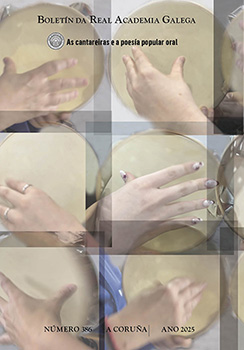
The songbook legacy. Ethnomusicological perspectives on the teaching of traditional galician female singers
Downloads
Published
How to Cite
Issue
Section
License

Accepted 2026-04-13
Published 2026-04-20
DOI:
https://doi.org/10.32766/brag.386.897Keywords:
Cantareiras, Community, Place, Sound archive, FoliadaAbstract
In this article, I reflect on the knowledge passed down by our cantareiras, or traditional Galician female singers. Unlike the kind transmitted through songbooks, this knowledge has emerged through the act of listening and remains inscribed in collective voice and bodies. This is a form of knowing that exceeds musical analysis as is commonly understood within Western academic practice and becomes visible in the very act of singing and dancing together. I therefore seek to explore ontologies of sound and movement: modes of existence and knowledge that go beyond written language. At the same time, I examine what it means to listen to these voices and bodies today. As the tradition of the cantareiras shows, the collective voice has also been a way of creating community, forging ties, and inhabiting territory. From this perspective, I propose that we understand community not as something given, but as something built and continually renewed through shared rituals conceived as constitutive and dissident acts. Therefore, beyond the logic of heritagization and nostalgia, their voices and bodies can help us to approach the present. At a time when late modernity tends toward sonic uniformity and the standardization of practices, the legacy of the cantigueiro or Galician songbook still offers another way of knowing and being in the world: one that understands our music and dance as living forces that continue to mark the collective coordinates of our territory.
Downloads
References
Arendt, Hannah (1996). Entre el pasado y el futuro. Ocho ejercicios sobre la reflexión política. Barcelona: Península.
Bernández, Senén, dir. (2008). Pandereteiras de Limiñoa. Alalá. 3ª tempada, capítulo 84. Guión de Teresa Abuín e Pilar G. Rego.
Castelao, Afonso Daniel (1964). As cruces de pedra na Galiza. A Coruña: Real Academia Galega.
Certeau, Michel de (2000). La invención de lo cotidiano. 1: Artes de hacer. Cidade de México: Universidad Iberoamericana.
Connerton, Paul (1989). How Societies Remember. Cambridge: Cambridge University Press.
Feixoo, Xulia e Guillerme, Ignacio (2017). Mulleres de Gargamala! Cantares de tradición oral. Santiago de Compostela: aCentral Folque.
Fraguas Fraguas, Antonio (2019 [1956] ). As coplas que se cantaban nas ruadas de Loureiro de Cotobade. Discurso de ingreso na Real Academia Galega. A Coruña: Real Academia Galega.
Giddens, Anthony (1990). The Consequences of Modernity. Cambridge: Polity Press.
Haraway, Donna J. (2019). Seguir con el problema. Generar parentesco en el Chthuluceno. Bilbao: Consonni.
Mandianes Castro, Manuel (1984). Loureses. Antropoloxía dunha parroquia galega. Vigo: Galaxia.
Mandianes Castro, Manuel (2009). Temporalidade do patrimonio. En: X. Antón Fidalgo Santamariña, Xosé Manuel Cid Fernández, Mariló Fernández Senra e Xulio Fernández Senra, coords. II Congreso de Patrimonio Etnográfico Galego. O patrimonio no século XXI. Ourense: Deputación de Ourense, 15-22.
Pedrayo, Ramón Otero (2019 [1956] ). Resposta ao discurso de ingreso de Antonio Fraguas Fraguas. En: Antonio Fraguas Fraguas, As coplas que se cantaban nas ruadas de Loureiro de Cotobade. A Coruña: Real Academia Galega, 31-36.
Stokes, Martin (1994). Introduction: Ethnicity, Identity and Music. En: Martin Stokes, ed. Ethnicity, Identity and Music: The Musical Construction of Place. Oxford: Berg, 1-27.
Taylor, Diana (2015). El archivo y el repertorio. La memoria cultural performática en las Américas. Santiago de Chile: Ediciones Universidad Alberto Hurtado.
Turner, Victor W. (1988). El proceso ritual. Estructura y antiestructura. Madrid: Taurus.